
What Are Facturas? The Short Answer
If you are searching for the best facturas near me, here is the short answer: facturas are the sweet pastries sold in Argentine and Uruguayan bakeries. They are small, syrup-glazed pastries made from enriched, laminated dough, filled with dulce de leche, pastry cream, quince paste or sweet potato paste. The most popular type is the medialuna, a small crescent-shaped pastry similar to a croissant but smaller, denser and sweeter. The best facturas near me will come from an Argentine or Uruguayan bakery or a Latin American market, sold fresh by the dozen and eaten the same day with coffee or mate.
There is no single pastry called a factura. “Facturas” is the umbrella name for a whole family of more than 20 sweet and a few savoury baked goods. This guide explains what they are, the types worth trying first, how to find the best facturas near me, and how to make medialunas at home.
What Facturas Are
Facturas are Argentina’s everyday pastries. Argentines buy them by the dozen, known as “una docena”, or by the half dozen, “media docena”, for breakfast and for the merienda, the afternoon snack. They are almost always eaten with coffee, usually café con leche, or with yerba mate, the caffeinated drink sipped through a metal straw called a bombilla.
Facturas were introduced by Italian, German and French immigrant confectioners who settled in Argentina in the late 19th and early 20th centuries, and Argentine bakers made the recipes their own. The dough is enriched and laminated, which means it is folded with butter or fat to create thin layers, and most facturas are brushed with a light sugar syrup, called almíbar, while they are still warm. That syrup glaze is what gives the best facturas near me their shine and their gentle sweetness.
One confusing detail: in Spanish, the word “factura” also means “invoice”. In Argentina and Uruguay, though, buying facturas means buying pastries, not paperwork. In Spain, similar pastries are called bollería, and in Mexico they are called pan dulce.
The Main Types of Facturas
A typical Buenos Aires bakery displays 12 to 20 varieties each morning, baked from 4:00 AM so everything is fresh. When you search for the best facturas near me, the case is what matters: a wide range of shapes and fillings, all baked that morning. Here are the types you are most likely to find.
Medialunas
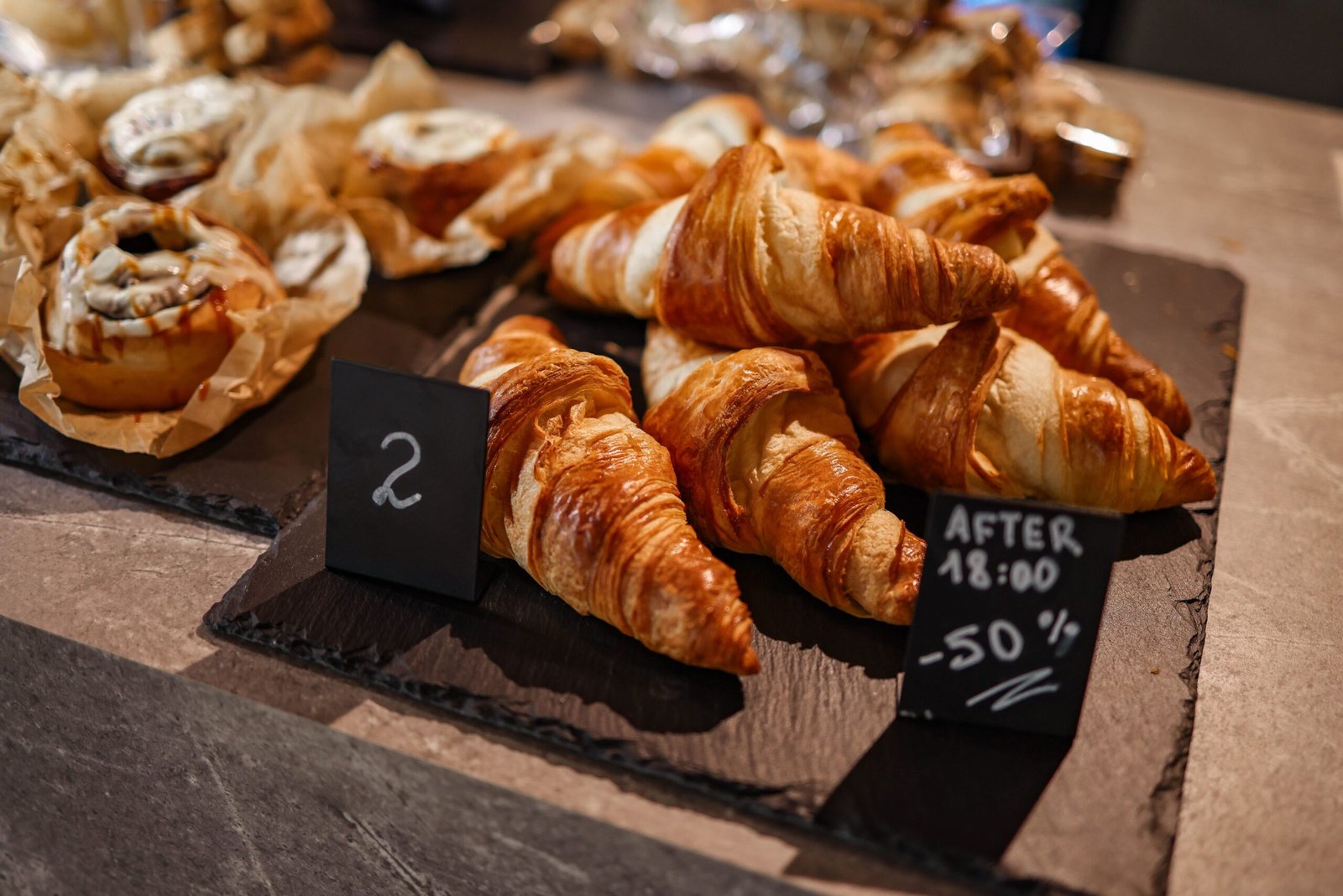
The medialuna, meaning “half moon”, is the undisputed star of the factura family: a small, dense croissant, smaller and sweeter than the French version thanks to its syrup coat. For most people searching for the best facturas near me, the medialuna is the first taste. It comes in two versions, de manteca and de grasa, explained below. A plain medialuna has no filling, just glazed, flaky dough, though some are filled with ham and cheese.
Vigilantes
Vigilantes are long, straight pastries of laminated dough, often topped with a strip of quince paste (membrillo) or sweet potato paste (dulce de batata) and a sprinkle of sugar. They are flaky and fruity, and pair well with black coffee.
Tortitas Negras
Tortitas negras, also called cara sucia (“dirty face”), are small, flat rounds topped with dark brown sugar, which caramelises in the oven into a crunchy-chewy crust. They are one of the oldest facturas, and a good choice if you prefer something less sweet than a filled pastry.
Bolas de Fraile
Bolas de fraile, literally “friar’s balls”, are round doughnuts without a hole, fried until golden, rolled in sugar or filled with dulce de leche or crema pastelera (pastry cream). They are soft, sweet and filling, and usually the first to sell out.
Cañoncitos de Dulce de Leche
Cañoncitos, or “little cannons”, are tubes of crisp puff pastry filled with dulce de leche and dusted with powdered sugar. If you love caramel flavours, cañoncitos are the factura for you.
Libritos and Sacramentos
Libritos, or “little books”, are flaky layers of dough folded to resemble a book, often eaten with cheese. Sacramentos are rectangular filled pastries, usually with ham and cheese or quince paste. Both are less sweet than the filled types, which makes them a good balance in a mixed dozen.
Other Types Worth Knowing
Beyond the classics, look out for suspiros de monja (small cream puffs), palmeritas (palm-shaped puff pastries with caramelised sugar), caracoles (spirals) and cremonas (a large, flaky pull-apart bread). Churros, usually filled with dulce de leche, are also sold in many panaderías.
Medialuna de Manteca vs Medialuna de Grasa
Every bakery makes both medialunas, and they taste quite different. A medialuna de manteca is made with butter: fluffy, soft and sweet, with a sticky glaze, and usually larger and puffier. It is the best starting point for a first-timer. A medialuna de grasa is made with lard or beef fat: thinner, crispier and flakier, with a savoury, slightly salty taste. Many Argentines prefer it with mate, because the salty edge balances the bitter drink. If you are unsure, order a mixed half dozen, three of each, and taste them side by side. That side-by-side test is the fastest way to find the best facturas near me for your taste.
When Argentines Eat Facturas
Facturas are morning and afternoon food rather than dessert. The classic contexts are breakfast and the merienda, and understanding both helps you know when to look for the best facturas near me. Bakeries open early, often between 6:00 and 7:00 AM. The merienda is the afternoon mini-meal, usually between 5:00 and 7:00 PM, which fills the gap before the famously late Argentine dinner, often served around 9:00 or 10:00 PM. Many bakeries close for the siesta and reopen for the merienda rush with a second batch baked fresh. Facturas are also the standard thing to bring when visiting someone’s house or to an office, which is why the dozen-in-a-box format exists.
How to Find the Best Facturas Near Me
The best facturas near me are rarely found in a supermarket or a generic café. Search online for an Argentine bakery, a panadería, or an Uruguayan bakery near you. These are the only places that make the full range, baked on the premises. A good sign is a glass case full of different shapes, all glazed and glossy, and the smell of fresh butter and sugar.
If there is no Argentine bakery near you, the best facturas near me may still be closer than you think: try Latin American grocery stores and markets. Some stock frozen medialunas you can bake at home, and some have a small bakery counter. Argentine restaurants and parrillas sometimes serve medialunas with coffee in the morning, and the staff will usually know where to find facturas even if they are not on the menu.
When you find a bakery, ask for “una docena surtida”, a mixed dozen, the normal way Argentines buy facturas. Ask which types are freshest, and whether the medialunas are de manteca or de grasa. For the sweetest experience, ask for cañoncitos de dulce de leche and bolas de fraile; for something lighter, ask for medialunas de manteca and tortitas negras.
Facturas are best within hours of baking, so judge freshness first. The glaze should look shiny, not dull or dried out, and a medialuna should feel soft and slightly sticky, not hard or stale. The best facturas near me are the ones baked that morning, so go early. Your first visit should be an experiment: a mixed dozen lets you taste the full range, and once you know your favourites, order a dozen of just those.
How to Make Medialunas at Home
If the best facturas near me are out of reach, you can still enjoy fresh medialunas at home. This is a simplified home version, not a professional bakery recipe, but it produces soft, sweet, glazed crescents that are close to the real thing.
You will need plain flour, milk, sugar, fresh yeast, butter, one egg, a pinch of salt, and a little honey or golden syrup for the glaze. Warm the milk until lukewarm, dissolve the yeast and a spoonful of sugar in it, and leave it for ten minutes until it foams. Mix the flour, sugar and salt, add the egg and the yeast mixture, and knead into a smooth, soft dough. Let it rise in a warm place for about an hour, until doubled in size.
Roll the dough into a large rectangle, spread softened butter over two thirds, and fold it in three, like a letter. Turn, roll and fold again, repeat once more, then rest the dough in the fridge for 30 minutes. This folding creates the thin layers that make a medialuna flaky. Roll the dough out once more, cut it into long triangles, roll each up from the wide end to the point, curve into a crescent and place on a lined tray. Let them rise for 30 to 45 minutes, then bake at around 200°C for 12 to 15 minutes until golden. While still warm, brush generously with a light sugar syrup of equal parts sugar and water, boiled and slightly cooled. Eat the same day, ideally warm, with coffee or mate.
Facturas vs Croissants: What Is the Difference?
People often ask whether a medialuna is just a croissant. It is not, although the two are cousins. The French croissant is larger, airier and more buttery, with a crisp outside and an open, layered inside. The medialuna is smaller, denser and sweeter, and coated in syrup, which the croissant is not. Croissant dough is laminated with butter and baked without a glaze; medialuna dough is enriched with milk, sugar and egg and brushed with almíbar while still warm. And while the croissant stands alone, the medialuna is one member of a much larger family, which is what makes the search for the best facturas near me so rewarding.
The Story Behind the Names
Many factura names carry anticlerical meanings, traced to the Argentine bakers’ union in the 1880s, when anarchist bakers during strikes gave their pastries provocative names mocking the church, the police and the military. Bolas de fraile (“friar’s balls”) and suspiros de monja (“nun’s sighs”) mock the church. Vigilantes (“the cops”) are said to be named after the police nightstick, or the officers who broke the bakers’ strike of 1888. Cañoncitos (“little cannons”) are tubes shaped like artillery, a nod to armed revolution. Even “factura” is part of the joke, since it also means “invoice”. The names stuck because they are funny, memorable and completely Argentine: a reminder that even a breakfast pastry can be a small act of rebellion.
Tips for Ordering Facturas
Go early for the freshest batch, or late afternoon for the second batch baked for the merienda. Order a mixed dozen first, ask whether the medialunas are de manteca or de grasa, and try both. Eat your facturas the same day, and always pair them with café con leche in the morning or a round of mate in the afternoon. That is how Argentines eat them, and it is how the best facturas near me taste best.
What are facturas?
Facturas are the sweet pastries sold in Argentine and Uruguayan bakeries: enriched, laminated dough, usually glazed with sugar syrup and filled with dulce de leche, pastry cream, quince paste or sweet potato paste. The family includes more than 20 types, and the best facturas near me will usually offer a dozen or more of them. The most popular is the medialuna.
Where can I find the best facturas near me?
The best facturas near me are found at an Argentine or Uruguayan bakery, known as a panadería, or at a Latin American market with a bakery counter. Look for a place that bakes fresh in the morning and sells facturas by the dozen. If there is no Argentine bakery nearby, some Latin markets sell frozen medialunas you can bake at home.
What is the most popular factura?
The medialuna is by far the most popular factura, and the first thing most people order when they find the best facturas near me. It is a small, dense croissant, smaller and sweeter than the French croissant, with a syrup glaze. It comes in two versions: de manteca, made with butter and soft and sweet, and de grasa, made with lard and thinner, crispier and slightly salty.
What is the difference between a medialuna and a croissant?
A medialuna is smaller, denser and sweeter than a French croissant, and brushed with sugar syrup while still warm. A croissant is larger, airier and more buttery, with a crisp outside and no glaze.
Are facturas sweet or savoury?
Most facturas are sweet, filled with dulce de leche, pastry cream, quince paste or sugar. A few are savoury, including medialunas de grasa, libritos and sacramentos filled with ham and cheese. A mixed dozen usually contains both sweet and savoury types.
How much do facturas cost?
Facturas are sold by the dozen or half dozen, and the price varies by country, city and bakery. In Argentina they are an affordable everyday food; outside Argentina, expect to pay more. Check the price list at the counter before ordering.
How long do facturas stay fresh?
Facturas are best eaten within a few hours of baking, while the glaze is shiny and the dough is soft. They are still good the same day, but lose crispness by the next day. Warm leftovers briefly in the oven to bring back some texture.
Can I make facturas at home?
Yes, medialunas are the easiest factura to make at home, using flour, milk, sugar, yeast, butter and egg, with a folding method for the flaky layers and a sugar syrup glaze. Cañoncitos and bolas de fraile are also possible at home, but need puff pastry or frying, so they take more practice.
Final Thoughts
The best facturas near me are not just a pastry. They are a daily ritual: a box of mixed facturas, a coffee or a mate, and a few unhurried minutes in the morning or the afternoon. Start with a medialuna, try a vigilante and a tortita negra, and save a cañoncito de dulce de leche for last.
For more food guides, recipes and bakery explainers, visit Smart Visions.
